Our Work
Advocacy: The purpose of pilotage and the safety of pilots on duty
The International Maritime Pilots' Association (IMPA) is the global body representing maritime pilots. We defend and promote maritime pilotage as a public service, and protect the safety of pilots.
We also maintain strong relations with international organisations and industry bodies.
Protecting the purpose of pilotage
What is maritime pilotage?
Maritime pilotage is a public service that allows coastal and port States to protect their social, economic and environmental interests.
According to research, pilotage, by bringing a pilot's highly localised knowledge and shiphandling skills, reduces the risk of a navigation incident by a factor of 528 compared with navigating without a pilot. This illustrative figure, drawn from Canada's experience, indicates the quantum of benefit that can be realised worldwide.
Pilotage is also highly effective. The International Group of P&I Clubs recorded 13 claims of $5 million or more between 1999 and 2018 — an incident rate of roughly 2.4 per 10 million acts of pilotage. Based on port call data from UNCTAD and IMF PortWatch, the estimated average annual number of acts of pilotage is 2.6 million (1999 - 2018), with over 3.6 million in 2025.
Together with the risk reduction described above, this shows the scale of risk that effective pilotage avoids.
It is worth reflecting that port calls may underestimate the number of acts of pilotage, as multiple acts can be associated with a ship making a port call, and transits of the Suez and Panama Canals and recommendatory pilotage areas, for example, the Strait of Malacca and Singapore, are excluded.
Pilotage is a public service, not a commercial one
Pilotage is often mistaken for a commercial service bought by shipowners, ports and terminals. It is not. Pilotage is a service established by governments in areas where it contributes to the safety of navigation in a more effective way than any other measure (IMO Resolution A.159(ES.IV)). Its principal beneficiaries are the publics of coastal and port States, whose social, economic and environmental interests it protects. The protection it provides and the value it generates are positive externalities — a navigation safety incident prevented benefits the State and the wider public far more than any single commercial party — and it can be quantified: research has derived a cost-benefit ratio of 1:58.6 — every dollar spent returns $58.60 in safety and efficiency benefits for the public.
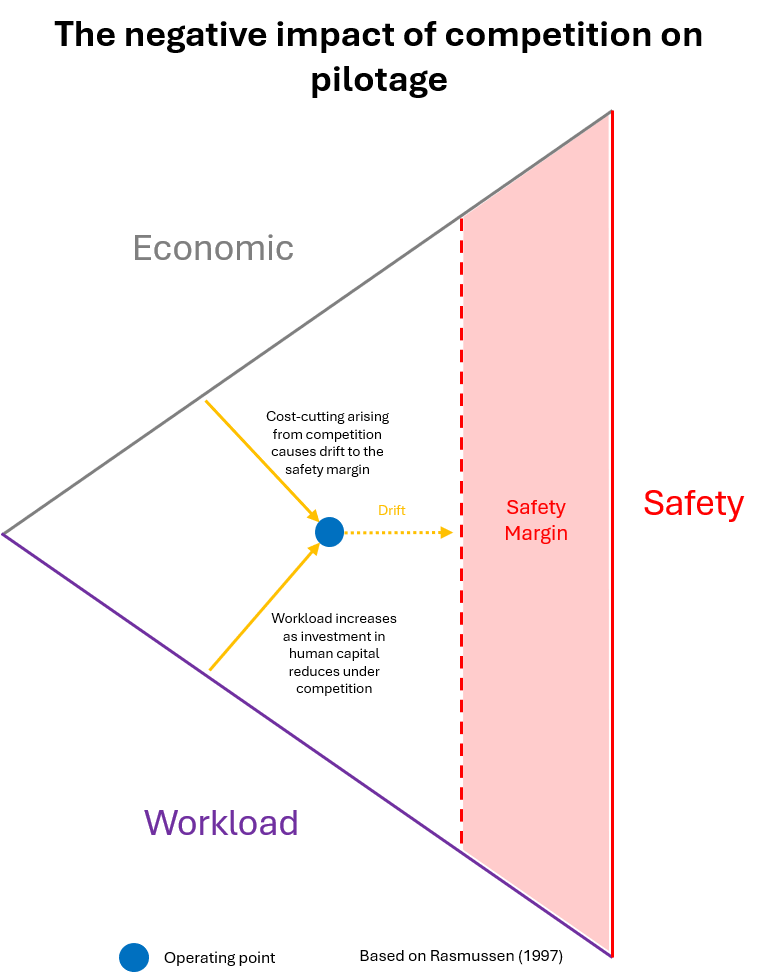
Those positive externalities are also why pilotage cannot be treated like an ordinary commercial service. It is not a pure public good in the economic sense, but its cost-and-risk structure is incompatible with competition — and the reason is structural, not rhetorical. Any sociotechnical operation runs inside a space bounded on one side by economic failure, on another by unacceptable workload, and on a third by the edge of safe performance. As Rasmussen showed, two everyday pressures act on working practice: a drive toward cost-efficiency and a drive toward least effort. Both push practice in the same direction — toward the safety boundary — and the migration is gradual, rational at each step, and invisible until an incident reveals where the boundary lies.
Competition steepens the cost-efficiency gradient. Splitting a pilotage area between providers, or requiring them to compete periodically to retain the service, rewards trimming the margin between everyday practice and the safety boundary — because that margin is a cost, and the provider who preserves it loses on price. A single, properly regulated provider is not safer because it is more virtuous; it is safer because it is not forced to compete that margin away, and can hold the operating point back from the edge. That is why the arrangement delivering the best safety outcome for the coastal State is a single, properly regulated provider in any given area or district.
The same public-safety logic shapes how pilots must work. Effective pilotage depends on a pilot applying unrivalled local knowledge and ship-handling skill, and exercising professional judgement free from commercial pressure. Two conditions protect that judgment:
- The first is the absence of competition, which has consequences for investment in human capital and for pilots' agency (shifting from the public to commercial interests).
- The second is the limitation of a pilot's personal liability except in cases of gross negligence: a pilot who fears personal exposure for an ordinary error of judgment is pushed toward defensive decisions rather than the decision that best serves safety.
Both conditions exist to serve the public interest in safe navigation, not the commercial interest of any party.
Policymakers who understand what pilotage is — and what it delivers — are better placed to establish and maintain effective systems, and to choose the right interventions when those systems need improvement.
Is pilotage a complex system?
Pilotage is a complex system. Its performance does not rest on any single component — the ship, the equipment, the pilot, the crew, the port, the weather, the regulatory regime — but rather emerges from the way they interact. This has a direct consequence for regulation: an intervention aimed at improving one part of the system can produce unintended effects elsewhere, and performance cannot be assured by inspecting parts in isolation. Understanding pilotage as a system is what allows interventions to be targeted where they genuinely improve performance, rather than where they merely appear to.
To put this understanding on a rigorous footing, IMPA is working with researchers at the Centre for Assuring Autonomy (CfAA) at the University of York, applying the Safer Complex Systems (SCS) Framework — a structured method for identifying how complex systems can drift toward failure and where the leverage for safety lies — to pilotage. With a Safety-II perspective, the work is designed to understand the causes, consequences and systemic failures arising from complexity, the exacerbating factors, and the necessary controls. Hamna factors analysis is also being used to understand how complexity directly affects pilots. The findings are expected to be reported later in 2026.
Pilotage is a complex system. IMPA is working with independent expert researchers from the Centre for Assuring Autonomy (CfAA) at the University of York, UK, to understand pilotage through the lens of complexity science and human factors. The results of this work, which applies the Safer Complex Systems (SCS) Framework to pilotage, are anticipated to be reported later in 2026.
Protecting the safety of pilots on duty
The embarkation and disembarkation of pilots at sea is conducted via a pilot boat and pilot transfer arrangement, or by helicopter landing or winching.
Are boat transfers and pilot ladders safe?
Pilot transfers are demanding operations, but the evidence shows they are safe when conducted properly. When pilot transfer arrangements are properly designed, manufactured, maintained and rigged, and pilots are fit for duty, trained, and properly equipped, IMPA estimates a fatality rate of 0.98 per million pilot transfers.
Observers tend to see transfer by pilot ladders as outdated and unsafe, but realistic alternatives are few, and we are frequently asked to consider proposals that are less safe than what is used today. IMPA continues to respond positively to all constructive approaches regarding alternatives to pilot ladders.
Our recent work pushing for improved international requirements for pilot transfer arrangements resulted in the IMO developing and adopting amendments to SOLAS regulation V/23 and new Performance standards for pilot transfer arrangements. These enter into force on 1 January 2028.
What about helicopter transfers?
Pilot transfers by helicopter occur in Australia, Canada, France, the Netherlands and the United States. The operational benefits and safety record of properly supported helicopter transfers are well established.
IMPA remains an active participant in ICS's work, maintaining industry best practices through the Guide to Helicopter/Ship Operations.
More information
Find more information on the safety of pilots on duty here.
Providing technical expertise to international forums
We ensure that international forums have direct access to pilots' technical expertise, including the International Maritime Organization (IMO), the International Organization for Marine Aids to Navigation (IALA), the International Organization for Standardization (ISO), and the International Electrotechnical Commission (IEC).